Adaptive Music
Interactive Albums and Apps: A Short History of Music Listeners Could Reshape
By the Starchild Music team · October 9, 2026 · 7 min read
The short answer
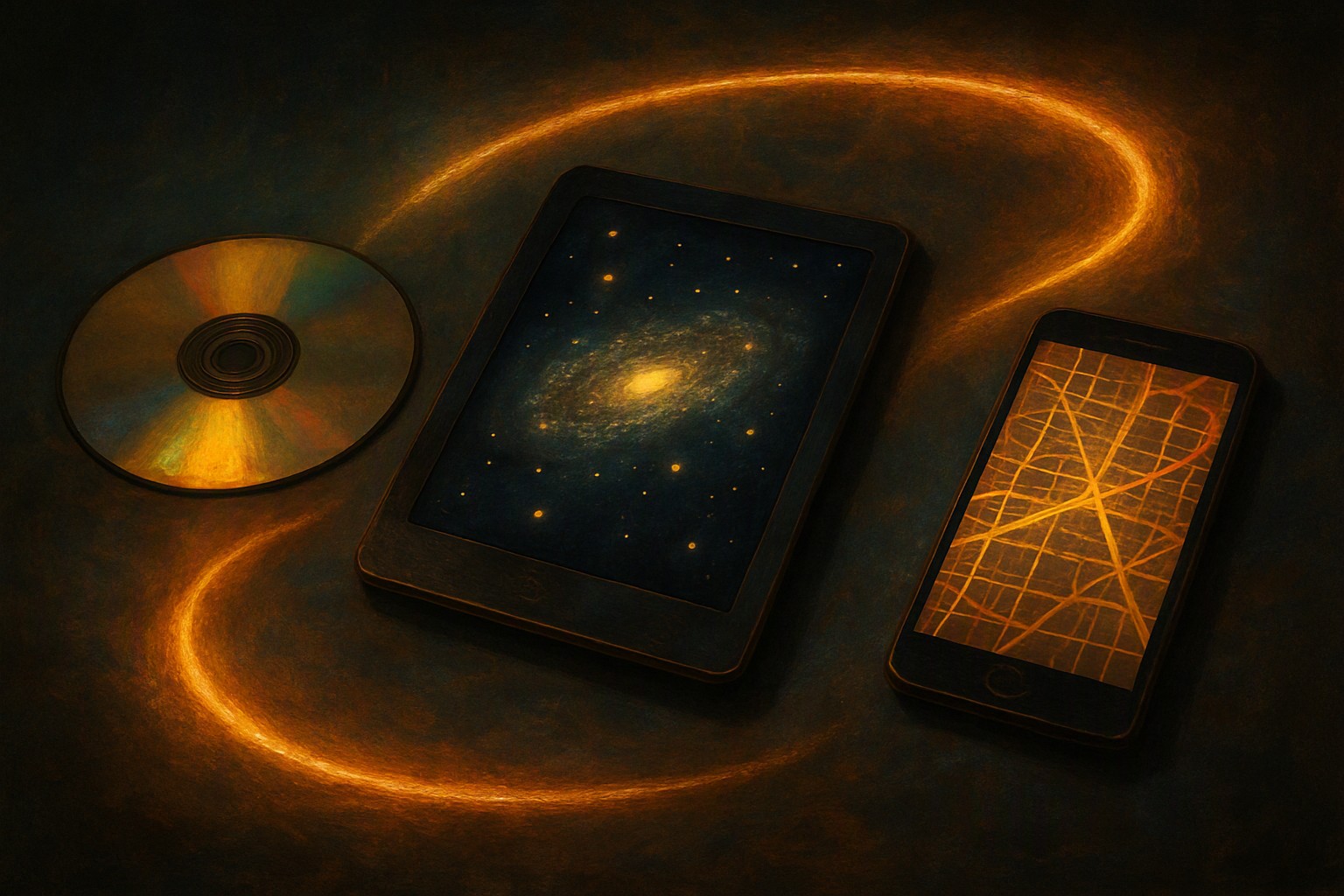
Interactive albums let listeners reshape the music itself. Todd Rundgren's No World Order (1993) let you steer tempo and mood across 933 short clips, Björk's Biophilia (2011) turned each song into a playable app, Bluebrain's The National Mall changed as you walked through Washington, D.C., and Massive Attack's Fantom (2016) remixed songs from phone sensors. The lasting lessons: interaction works best when it serves the song, and formats tied to one device age quickly.
Recorded music has mostly been a finished object: you press play and hear what the artist decided. Every few years, though, an artist tries to hand some of that decision-making to the listener. The results include some of the most interesting experiments in popular music, and at least one of them now sits in a museum collection.
Here are four well-documented examples, in order, with what each one teaches.
1993: Todd Rundgren's No World Order
Todd Rundgren released No World Order in 1993 in two forms: a regular CD and an interactive version for the Philips CD-i player. Sound On Sound's 1994 profile describes the interactive disc as 933 short musical clips that listeners could arrange in millions of combinations with a joystick. Controls covered direction (forward, reverse or looping), form, tempo from 86 to 132 BPM, mood from bright to dark, and mix density, all the way down to a karaoke setting.
Rundgren also included sequences built by four producers, Bob Clearmountain, Don Was, Jerry Harrison and Hal Willner, which listeners could play and manipulate in real time. He described the experience as moving through a musical space like an aquarium: you swim in one musical direction until you decide to change your vector.
The album also came out as a conventional CD, one fixed sequence for people without a CD-i player. That pairing became common for interactive releases: a familiar version for most listeners, and a playable one for people who want to go further.
The lesson: Rundgren offered freedom and curated paths at the same time. Most people do not want a blank canvas every time they press play, and a starting point from a trusted producer makes exploring more fun.
2011: Björk's Biophilia
Touchscreens made interaction feel natural. Björk released Biophilia in 2011 as an album and an app for iPad, iPhone and iPod touch. Opening the app reveals a galaxy in which each of the album's 10 songs is a bright star, and touching a star launches a mini-app where you can both listen to the song and contribute to it.
MoMA's description, written when the museum added Biophilia to its collection in 2014 as its first downloadable app, gives a sense of how deep the interaction went. In "Solstice", players control the orbits of planets, and each planet controls part of the string music under Björk's voice, so the arrangement can be spare or densely layered; players can record and save their own version. In "Virus", players can stop a virus attacking a cell, but if they succeed, the song stops. Only by letting the virus win do they hear the rest.
The lesson: the best interactions carry meaning. "Virus" makes the listener's choice part of the song's story, which is far more memorable than a mixing slider.
2011: Bluebrain's The National Mall
The Washington band Bluebrain made an album that only works in one place. Engadget reported in April 2011 that The National Mall, an iPhone app, uses GPS to track hundreds of tagged zones across the National Mall in Washington, D.C., and adjusts the rhythm, melody, instrumentation and pace of the music as you walk between landmarks. The experience, as described there, is strictly location specific, with no user input necessary, or available.
The lesson: interaction does not have to mean buttons. Walking was the interface, so the music followed you and there was nothing to steer by hand. Bluebrain also announced plans for more location-aware albums, a sign that the idea traveled.
2016: Massive Attack's Fantom
Massive Attack's Fantom app, released in January 2016 for iPhone, pushed the sensor idea further. Engadget described it remixing the band's new songs using the phone's camera, its motion and the time of day, plus your heartbeat if you wore an Apple Watch. Different portions of a song play depending on when you listen, and listeners could save their personal versions or share them to social media.
The lesson: sensor-driven music can feel personal, and it also ties the experience to specific hardware. Fantom required an iPhone 5S or later, and the heart-rate feature needed a watch. It also asked very little of the listener, who only had to live their day while the app did the remixing, which is a different idea of interactivity from Biophilia's hands-on play.
What these releases teach
- Interaction should serve the song. Biophilia's best moments make the listener's actions mean something inside the music.
- Offer paths as well as freedom. Rundgren's producer sequences gave people a way in before they started steering.
- Hardware ages fast. CD-i is long gone, and apps depend on operating systems that keep changing. MoMA notes that it set up a protocol covering the code, files, conservation and display of its digital acquisitions, which shows how much care these works need to survive.
- Keep the song recognizable. In every case above, the songs stayed songs, with a voice and an identity, while the listener changed how they unfolded.
Where this leads
The ideas these albums tested are moving into ordinary players. On Starchild, each song in a catalog of about 7,000 originals is produced in many styles around the same vocal, and listeners can switch between them mid-song, or change tempo and key, without losing their place. It is a narrower kind of interactivity than Biophilia's galaxy, and because it runs in a web browser, including on phones, it avoids depending on one app or device. Try it on any song page, or read what an adaptive song is for the background and why multiple productions change a song's value for the business side.
Looking back across three decades, the pattern is clear. Each generation of hardware produced a few ambitious interactive releases, admired and then hard to play a few years later. The ideas that last are the simple ones: let people hear a song more than one way, keep the song itself intact, and make the controls feel like part of the music.
Sources
- Sound On Sound: Todd Rundgren, Interactive Music, Recording Adventures in Utopia
- MoMA: Biophilia, the first app in MoMA's collection
- Nonesuch Records: Björk's Biophilia becomes first app in MoMA collection
- Engadget: Location-aware album gives Washington DC dynamically modified soundtrack
- Engadget: Remix Massive Attack's new songs with a sensor-aware iPhone app