Adaptive Music
What Is Diegetic vs Non-Diegetic Music in Video Games?
By the Starchild Music team · November 21, 2026 · 6 min read
The short answer
Diegetic music comes from a source inside the game world, such as a car radio, a jukebox or a band in a tavern, so the characters could hear it. Non-diegetic music, like most scores, exists only for the player. Games blur the line, because non-diegetic music can still tell the player where danger is. Scholars call that overlap transdiegetic.
Diegetic music is music that exists inside the story world. Non-diegetic music exists outside it. The words come from film study. As researcher Michiel Kamp explains, they were used to "denote the difference between music that originates in a film's narrative world (or diegesis), and music that does not."
In a game, a radio playing in a car is diegetic: the character could hear it. A swelling orchestra when the boss appears is non-diegetic: only you hear it. Games add a twist, because you are not just watching. Your actions respond to the music, and that muddies the line.
Diegetic music: music with a source in the world
Game audio writer Jaime Cross puts it simply: diegetic music gives "music a source within the game world." In his Game Developer article he says that placing an emitter such as a radio "gives it a reason to be there," and that this helps with world building, "as it allows you to give a game space its own musical culture."
His main example is Grand Theft Auto, where radio stations play in cars. Because they are radio stations, "any other person in that world could be listening." The sound changes with the environment, so it is muffled outside a vehicle, and in GTA V the radio signals themselves "can drop out depending on where you are in the world."
You can tell diegetic music by what it does. It moves with the world. It gets louder as you walk toward the jukebox. It can be switched off at the source.
Non-diegetic music: the score only you hear
Most game scores are non-diegetic. Kamp notes that most musical soundtracks are "not part of the game world." Unlike diegetic sound effects, background music "does not 'move' between audio channels or increase or decrease in volume to correspond with movement through the game world." It also has no visible source, such as a record player or a performer, so the player does not hear it as something "out there" to be looked for.
That is not a weakness. Kamp argues that non-diegetic music can structure how a player reads a situation. In Super Mario Bros., he points out, the menu is silent, the music starts with the level, loops until the level ends or Mario dies, and then a coda plays and the music stops abruptly. Those breaks mark each of Mario's lives as its own stretch of play.
Where games blur the line: transdiegetic
Film viewers do not act on the score. Players do. Kamp gives an example: a character walks down a hallway and suddenly draws a weapon, and then a monster appears. What prompted the vigilance? "The player, who heard nondiegetic music signifying danger." He says this too can be seen as a case of transdiegesis, a term from game scholar Kristine Jørgensen. She used it for avatar-player interaction, such as a character who suddenly says "I'm low on mana" to the player.
Kamp does not drop the old terms. He writes that these qualities "pose a theoretical problem," but that for a player, background music "is phenomenologically nondiegetic." In plain words: it feels like it is outside the world, even while it guides what you do inside it.
Kamp also notes that in many games the diegesis is incomplete. He asks "what is diegetic in Tetris? The blocks?" Some games need no such split at all.
Does it matter in VR?
Yes, because presence is the point. Composer Winifred Phillips writes that "in VR, the idea of presence becomes paramount," and that non-diegetic music risks prompting players to ask "Why am I hearing it?" Positional, 3D music tends to feel like part of the fiction, and a direct stereo mix tends to feel external. A fully diegetic score is possible, but she says most games will not be able to do it.
Her work on the game Dragon Front shows a middle way. The main theme starts as a stereo mix and moves to a spatialized in-game radio that players can locate and turn off. For how placing sound in space changes scoring, see spatial audio and adaptive scoring.
A made-up example: one song, three roles
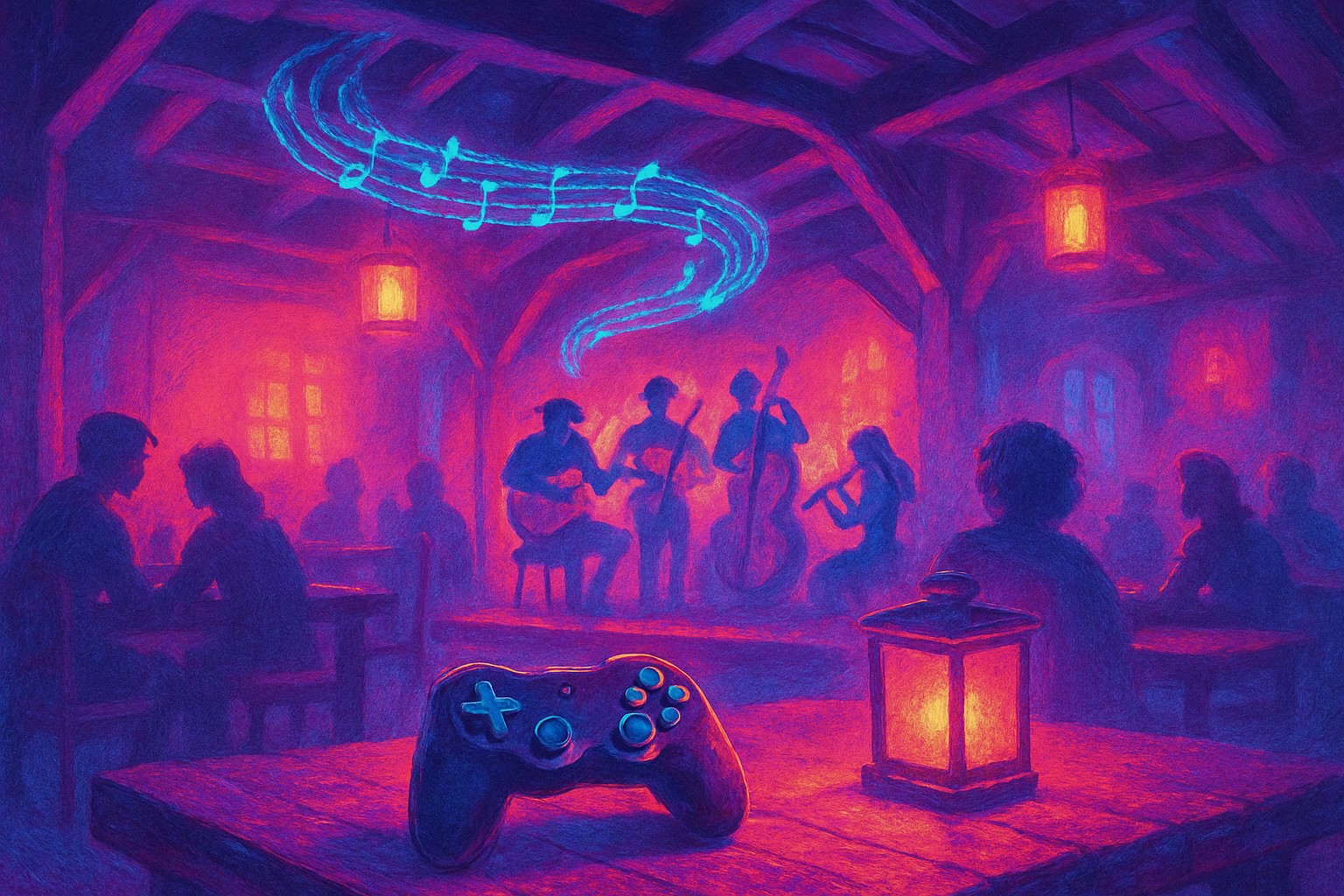
Say a player enters a tavern in a fantasy game.
- Outside: a calm non-diegetic theme plays across the town square.
- At the door: the theme fades and a lute is heard from inside. It grows louder as the player nears the door, and it is muffled behind the wall. That is diegetic.
- Inside: the band plays the same tune, now in the room. A diegetic switch has happened without a break.
- Fight breaks out: the band stops and a tense score rises from nowhere. That is non-diegetic, and a clue that the player should draw their sword.
Because the tune stays the same, the player feels one world, not four tracks. Writing a melody that works as a lute piece and as a full arrangement is a skill of its own. For how to design for that, see designing a song so it can adapt.
Why this matters for accessibility
Kamp quotes researcher Mark Grimshaw's observation that many games "do recognise a distinction between diegetic and nondiegetic sound through the inclusion of separate volume controls for sound effects and music." That split can help. If a player turns the music down, the diegetic radio should not carry vital information the player then misses. Use a second signal for anything important. See accessibility and adaptive music.
Do this today
- List every piece of music in your game or project. Mark each one: world source, or only for the player.
- For each diegetic piece, check that it behaves like a thing in the world: louder near, muffled behind walls, switchable at the source.
- For each non-diegetic cue that tells the player something, such as danger, ask what else shows the same thing.
- Look for a place where a tune can pass from one kind to the other, as in the tavern.
Sources
Find a song to license
Every song on Starchild can be heard in different styles and in your key before you license it.