Adaptive Music
Generative, Adaptive and Procedural Music: What Is the Difference?
By the Starchild Music team · October 16, 2026 · 5 min read
The short answer
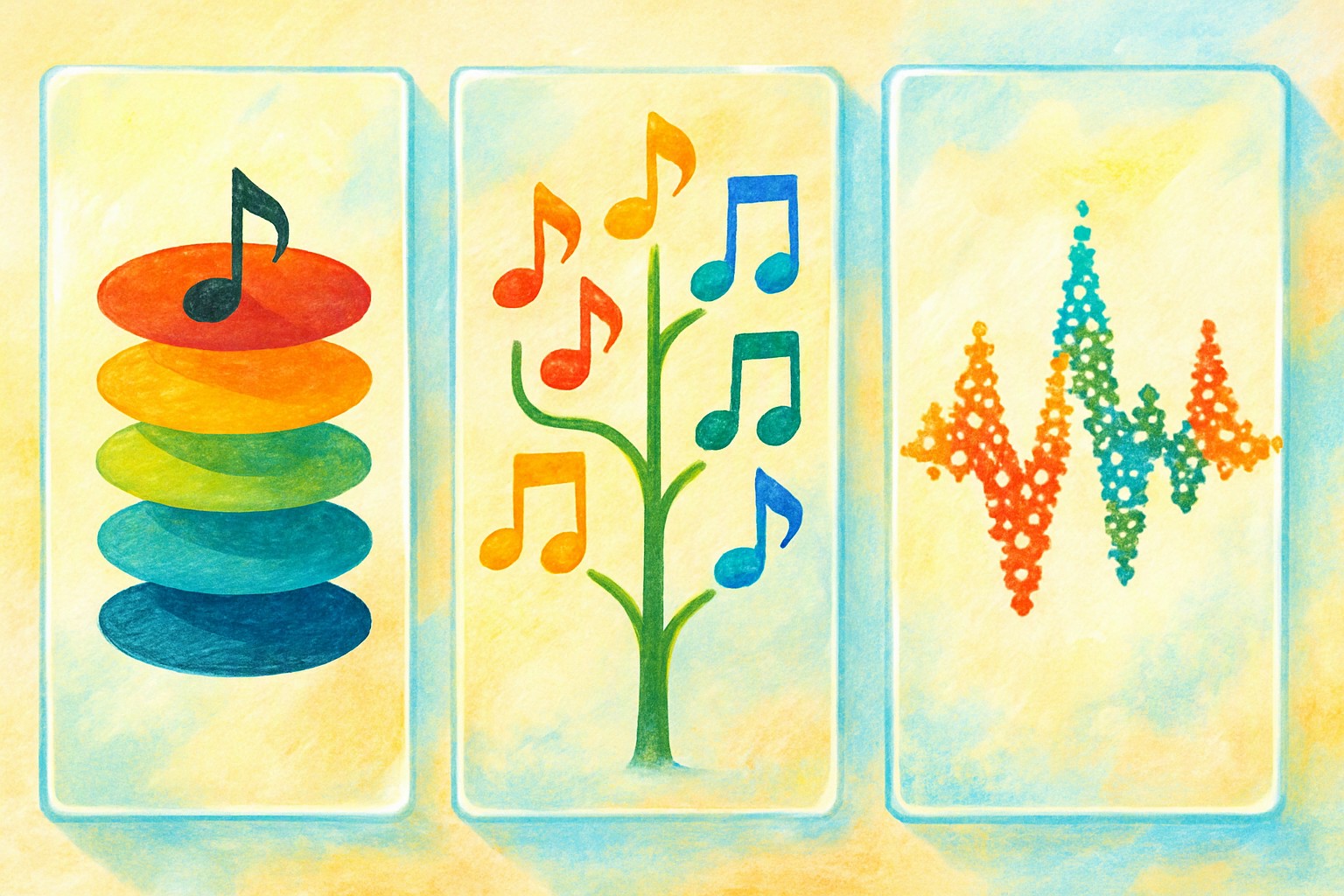
Adaptive music rearranges music that people composed in advance as the situation changes. Generative music uses rules or software to create the music itself. Procedural audio means building sounds from algorithms instead of playing recordings, so the three overlap but answer different questions: what changes the music, who or what wrote it, and how the sound is made.
People use "adaptive," "generative" and "procedural" as if they mean the same thing. They do not, and mixing them up leads to muddled arguments about what is human-made, what is automated and what is simply flexible.
Here is a plain way to tell them apart, with examples from game audio, Brian Eno and sound design.
Adaptive music: pre-made parts, flexible order
Philippe Pasquier and Cale Plut, writing in Game Developer, describe adaptive music as music that changes based on gameplay, in real time, in response to player actions and game state. The notes were written by people ahead of time. What changes is which parts play and when.
They cite familiar examples. Mass Effect adds layers as combat intensifies, and Doom (2016) picks "verse" and "chorus" sections by intensity. Our own explainer on how video games make music adapt shows the techniques in detail.
Generative music: rules that write the music
Generative music hands part of the composing to a system. Pasquier and Plut define it as music made with "some degree of systemic automation," where a machine does the composing, assistant composing, orchestrating, arranging or performing.
Brian Eno gave a famous description in a 1996 talk. He said it is possible to think of "a system or a set of rules which once set in motion will create music for you," and contrasted this with the composer as someone who "creates a complete image."
That same year, Eno worked with Tim and Pete Cole on a generative album delivered on floppy disk. Create Digital Music, describing its restoration, notes that each "song" was only a file of rules, variables and instructions sent to a computer's sound card, so each rendition was created anew.
Procedural audio: sound as a process
Procedural audio is a different axis. It concerns how a sound is made, not what the music does. Andy Farnell, author of the book Designing Sound, defines it as "a philosophy about sound being a process and not data."
He adds that the method matters little: it is as irrelevant "as whether you use oils or water colours is to painting." A footstep that is synthesized from a model of how feet and surfaces behave, rather than played from a recording, is procedural. It could be used in a completely linear film.
Where they meet
Real projects blend these. Pasquier and Plut cite No Man's Sky as generating music by arranging fragments to suit the environment, and Spore as using generative music during creature creation. Create Digital Music reported that Eno would create a fully procedural sound score for Spore, "to make the music as generative as the game itself."
Pasquier and Plut also note a split in how people work. The games industry tends to focus on arranging pre-composed clips with automated systems. Academic research tends to focus on real-time automated composition, performance and arrangement.
Four questions that sort any piece of music
When you meet a new product or project, four questions usually settle which word fits:
- Who wrote the notes? If people did, ahead of time, the music is pre-composed. If a system chose them, it is generative.
- What causes the change? If the listener, player or environment does, it is adaptive or interactive. If only the rules and time do, it is generative without being adaptive.
- How is the sound produced? If it comes from recordings, it is sample-based. If it is computed from a model, it is procedural.
- Is it different each time? Not automatically. Adaptive music can be fully repeatable if the player does the same thing.
Why the distinction matters for songwriters
For songwriters and artists, the useful point is that flexible does not mean automated. A song can be adaptive, in the sense that it can be heard in several finished production styles, tempos and voices, while still being completely human-written.
Starchild's catalog is built on songs written by professional songwriters. What can vary is the production around the song, not the authorship of the song itself. See what an adaptive song is for that use of the word.
Naming things correctly helps everyone. A listener who knows the difference between a rule-driven piece and a human-written song with flexible production can decide what they actually want to hear.
Three common mix-ups
Shuffle is not adaptive. A playlist that plays songs in random order changes the sequence, but each song is fixed, and nothing responds to you or to the situation. It is closer to a deck of cards than to a score.
A generated file is not necessarily generative in real time. Music created by software once and then saved as a normal recording is a fixed piece. The generative idea Eno described is a system that keeps making new material while it runs, with each rendition created anew.
And procedural does not mean random. Farnell's point is that a model of how a sound behaves can respond to events in a dynamic space. The sound follows rules that tie it to what is happening, which is the opposite of chaos.
Why the vocabulary is worth getting right
Clear words help artists make informed choices. If someone offers you music that is adaptive, you can ask what changes and who wrote the notes. If someone offers generative music, you can ask about the rules, and whether people shaped them.
These are neutral questions, not accusations. All three approaches are legitimate, and many fine works combine them. The point is only that a single label should not hide the differences.
Next time you read about a new music product, try the four questions above. The answers usually take less than a minute and tell you most of what you need to know.
Sources
- Game Developer: Deep Dive, A framework for generative music in video games (Pasquier and Plut)
- In Motion Magazine: Brian Eno, Generative Music (1996 talk transcript)
- Create Digital Music: Two-plus hours of Brian Eno music generated in 1996, running on Windows 3.11
- Create Digital Music: Brian Eno to create generative soundtrack for Spore
- Designing Sound: Procedural audio, interview with Andy Farnell